One of the most rewarding parts of this work is watching a student go from learning to use a tool to knowing why that tool works — and then to designing a better one. That transition from technician to scientist is what good mentorship is supposed to produce, and it doesn’t happen automatically. It requires deliberate effort from everyone in a research group, starting with the people at the top.
My approach to mentorship is organized around a simple belief: independence is the goal, not the reward. I try to involve students in meaningful scientific decisions from early in their time working with me — not by throwing them into the deep end without support, but by treating them as capable of forming opinions and then helping them develop the tools to defend those opinions rigorously. This means spending time on scientific writing and communication skills, not just technical skills. It means regularly asking “what do you think we should do next, and why?” before offering my own view. And it means being honest about what I don’t know, because students who never see their mentors be uncertain tend to underestimate how much uncertainty is a normal part of research.
I have also come to believe strongly that research group culture is not separate from research quality — it is a determinant of it. Groups where people feel safe to ask questions, admit confusion, and take intellectual risks produce better science than groups where no one asks a question they don’t already know the answer to. Building that kind of culture requires active attention, especially in a field like fusion where the physics is genuinely hard and the pressure to appear competent can be intense. My involvement with CONNECT, the APS-DPP student committee, and community-building efforts at DIII-D all stem from the same conviction: the environment shapes the science.
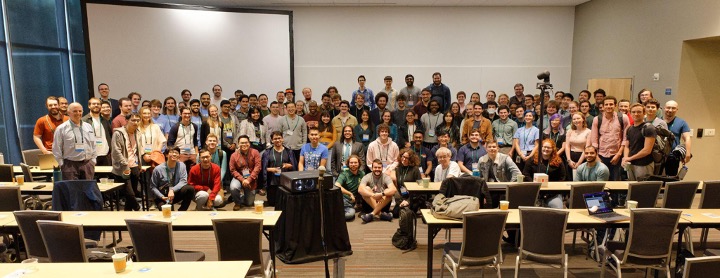 APS-DPP Student Day 2022, organized by CONNECT. Events like this reduce the activation energy for students to participate in the broader scientific community.
On the instructional side, I have found that design-based learning is among the most effective formats for developing physical intuition. In the joint Columbia/Princeton/MIT fusion power plant design courses I have instructed, students are asked to design a complete fusion device from scratch — not just compute plasma physics, but make engineering tradeoffs, defend choices in the face of constraints, and iterate when their first design fails. The experience of watching a plasma scenario they designed fail a neutron wall loading constraint, and then figuring out how to fix it, teaches more about tokamak physics than any amount of lecture. This is also the philosophy behind the weekly graduate-level plasma seminar I founded at Columbia: students teach each other, in their own words, and the act of preparing to explain something clearly forces a depth of understanding that passive learning rarely achieves.
The fusion field is growing rapidly, and the demand for trained scientists and engineers is growing faster than our current pipeline can supply. I take this seriously as a responsibility. The students who work with me today will be solving problems in 2040 that we cannot fully anticipate right now. My job is less to teach them what I know and more to help them develop the judgment, habits of mind, and collaborative instincts to figure out whatever comes next.