Every fusion pilot plant (FPP) design rests on a stack of physics models: models for the plasma equilibrium, for transport, for stability, and for the edge pedestal that sets much of the plasma performance. Most of these models were developed and tested on today’s experiments, and an FPP will operate well outside the conditions where they have been checked. That makes verification, validation and uncertainty quantification (VVUQ) one of the most practical problems in fusion today. If we don’t know how much to trust a prediction, a conservative design has to carry extra margin to guarantee its minimum performance, and that margin is paid for directly in machine size, complexity and capital cost.
A large part of my recent work at the DIII-D National Fusion Facility, in collaboration with the VVUQ and data science teams at General Atomics, has focused on building the tools and workflows needed to turn “the model agrees with the data” into a quantitative, reproducible statement with honest error bars.
Measurements with uncertainties: Integrated Data Analysis
Validation starts with the measurements. Any physics quantity we want to compare to a model (a temperature profile, a pedestal height, a current density) is inferred from many diagnostics, each with its own calibrations, systematic errors and spatial mapping. Integrated Data Analysis (IDA) tackles this by fitting all of the relevant diagnostics jointly in a Bayesian framework. Thomson scattering, charge-exchange recombination spectroscopy, interferometry, reflectometry, ECE and visible bremsstrahlung measurements are forward-modeled together, and the result is not a single “best fit” profile but a full posterior distribution: a profile with a physically meaningful uncertainty band.
I have been working with the IDA team at GA to deploy these fits across large DIII-D databases, assess their quality in ELM-free scenarios, and design dedicated experiments that produce clean datasets for demonstrating what IDA can do.
Propagating uncertainty: equilibrium bouquets
Profile uncertainties only matter if they carry through to the quantities we actually care about. One of the newer tools I have been helping develop is a perturbed-equilibrium “bouquet” workflow. Instead of reconstructing one magnetic equilibrium for a given time slice, the bouquet perturbs the measured inputs within their error bars, re-solves the Grad-Shafranov equation for each draw using TokaMaker, and keeps the family of equilibria that the machine could actually have produced. The spread across that family is then a direct measure of how uncertain our equilibrium (and anything computed from it, such as stability or transport) really is. The workflow is built on IMAS data structures and connects to FUSE, which allows postdictive reconstructions of DIII-D discharges to feed straight into the same integrated modeling tools used for power plant design. This builds on earlier work by my students and collaborators showing how sensitive downstream physics models can be to equilibrium variation.
Validating EPED for ELM-free power plants
These pieces come together in a validation study of the EPED pedestal model in ELM-free regimes. EPED predicts the height and width of the edge pedestal by combining two limits, peeling-ballooning stability (the trigger for edge localized modes, or ELMs) and kinetic ballooning modes (which clamp the pedestal gradient). It has been validated extensively in plasmas with ELMs, and it is now the standard pedestal model used in FPP design studies. The catch is that an FPP must operate without large ELMs, and every ELM-free regime we know of works by adding some other edge transport channel that holds the pedestal below the ELM limit.
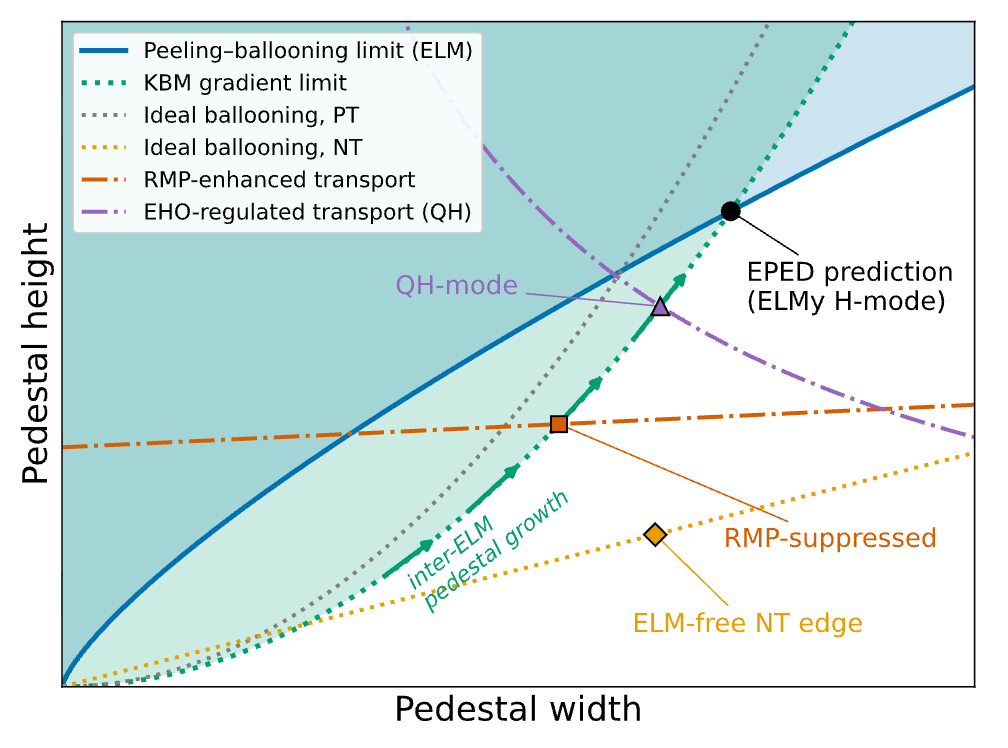 A schematic of how different ELM-free regimes can hold the pedestal below the ELMy H-mode EPED prediction. Each regime adds its own edge transport mechanism: RMP-enhanced transport, the edge harmonic oscillation in QH-mode, or the ideal ballooning limit in negative triangularity.
Using IDA profiles across a database of thousands of stationary phases from more than 1600 DIII-D discharges and ten different ELMy, small-ELM and ELM-free regimes, we compared measured pedestals to EPED predictions in a statistical way. We find that the measured pedestal pressure falls systematically below the EPED prediction in nearly every ELM-free regime, and that this “pedestal penalty” is not a fixed offset but depends on the plasma conditions. Using FUSE, we then showed that penalties well within the range observed on DIII-D can cut the projected fusion power of an ITER-like scenario substantially, which highlights the need for regime-specific pedestal models in future FPP design. This work is currently under review and is part of a broader effort to organize validation around focused “sprints” that each define a quantity of interest, a falsifiable test against data, and a clear path to FPP-relevant conditions.
Where machine learning fits in
Much of this is only possible because of machine learning, and in turn, VVUQ is what makes machine learning trustworthy enough to use for design. The EPED comparison above relies on EPED-NN, a neural-network surrogate that reproduces thousands of full EPED calculations orders of magnitude faster, which is what makes database-scale validation practical. Similar surrogates for turbulent transport, like neural-network emulators of TGLF and CGYRO, are being validated across DIII-D, MAST-U and NSTX so they can be used with confidence in whole-device modeling. Gaussian process regression provides a natural way to fit profiles with uncertainty and to quantify the resolution limits of pedestal measurements, and ML tools for diagnostic super-resolution, ELM forecasting and regime classification are helping us extract more physics from every discharge.
The common thread is that a surrogate is only as useful as our knowledge of where it can be trusted. Bayesian fits like IDA give ML models better-labeled training data, uncertainty propagation tells us how surrogate errors affect a design, and validation sprints define when a model (ML or physics-based) has earned a place in an FPP design workflow. Combined with the Integrated Research Infrastructure that lets us run these analyses at scale, I believe this approach will be central to designing fusion power plants that work the first time.
Selected publications on this subject:
Several publications on this subject, including the ELM-free EPED validation study, are currently under review.
Assessing the numerical stability of physics models to equilibrium variation through database comparisons on DIII-D
Rothstein, A., Ailiani, V., Krogen, K., Nelson, A. O., Sun, X., Kim, M. S., Boyes, W., Logan, N. C., Xing, Z. A., Kolemen, E. & the DIII-D Team, Plasma Physics and Controlled Fusion, 67, 115006 (2025).
Quantifying Resolution Limits in Pedestal Profile Measurements with Gaussian Process Regression
Cao, N., Hatch, D. R., Michoski, C., Oliver, T. A., Eldon, D., Nelson, A. O. & Waller, M., Nuclear Fusion, 66, 026016 (2026).
A Gaussian Process Guide for Signal Regression in Magnetic Fusion
Michoski, C., Oliver, T. A., Hatch, D. R., Diallo, A., Kotschenreuther, M., Eldon, D., Waller, M., Groebner, R. & Nelson, A. O., Nuclear Fusion, 64, 035001 (2024).
Spatiotemporal Forecasting of the Edge Localized Modes in Tokamak Plasmas Using Neural Networks
Samaddar, A., Gong, Q., Madireddy, S., Hansen, C. J., Joung, S., Smith, D. R., Sun, Y., Ebrahimi, F., Balaprakash, P. & Nelson, A. O., Machine Learning: Science and Technology, 6, 035041 (2025).
Exploring the fusion power plant design space: comparative analysis of positive and negative triangularity tokamaks through optimization
Slendebroek, T., Nelson, A. O., Meneghini, O. et al., Nuclear Fusion 66, 026032 (2026).