On July 21st, 2026, I had the pleasure of giving a “Fusion Energy 101” talk at the inaugural Colorado Fusion Week in Golden, Colorado. Hosted by Colorado Cleantech in partnership with the CleanTech Alliance, the three-day event brought together fusion companies, researchers, policymakers, investors and industry leaders for panels, keynote discussions, facility tours and plenty of networking, all with the goal of strengthening the ecosystem needed to bring fusion energy to market. I am very grateful to the organizers for the invitation, and congratulate them on putting together such a fantastic event in its very first year! It was also wonderful to see Governor Jared Polis join the conversation, which says a lot about how seriously Colorado is taking the opportunity in front of it.
My talk was aimed at giving a broad audience a common foundation for the rest of the week. I started with why we pursue fusion: the motivation goes well beyond climate change, since energy access is closely tied to quality of life (GDP, life expectancy, and water and food security all rise with energy use) and roughly 1.2 billion people still live without electricity. Fusion could supply firm power for AI and data centers, high-grade process heat for heavy industry, and energy for desalination and carbon capture, all from an abundant fuel with no long-term waste and no possibility of meltdown. From there, I covered the basics of plasmas (the 4th state of matter, making up over 99% of the visible universe), how fusion differs from fission, why fusion requires temperatures comparable to the core of the Sun, and how the Lawson criterion sets the bar for density, temperature and confinement time. I then walked through the many ways people are trying to get there, including magnetic confinement devices like tokamaks and stellarators, laser-based inertial confinement (the first approach to achieve scientific breakeven, and the main approach pursued here in the Colorado area!) and a variety of magneto-inertial and alternative concepts, each with its own challenges left to solve.
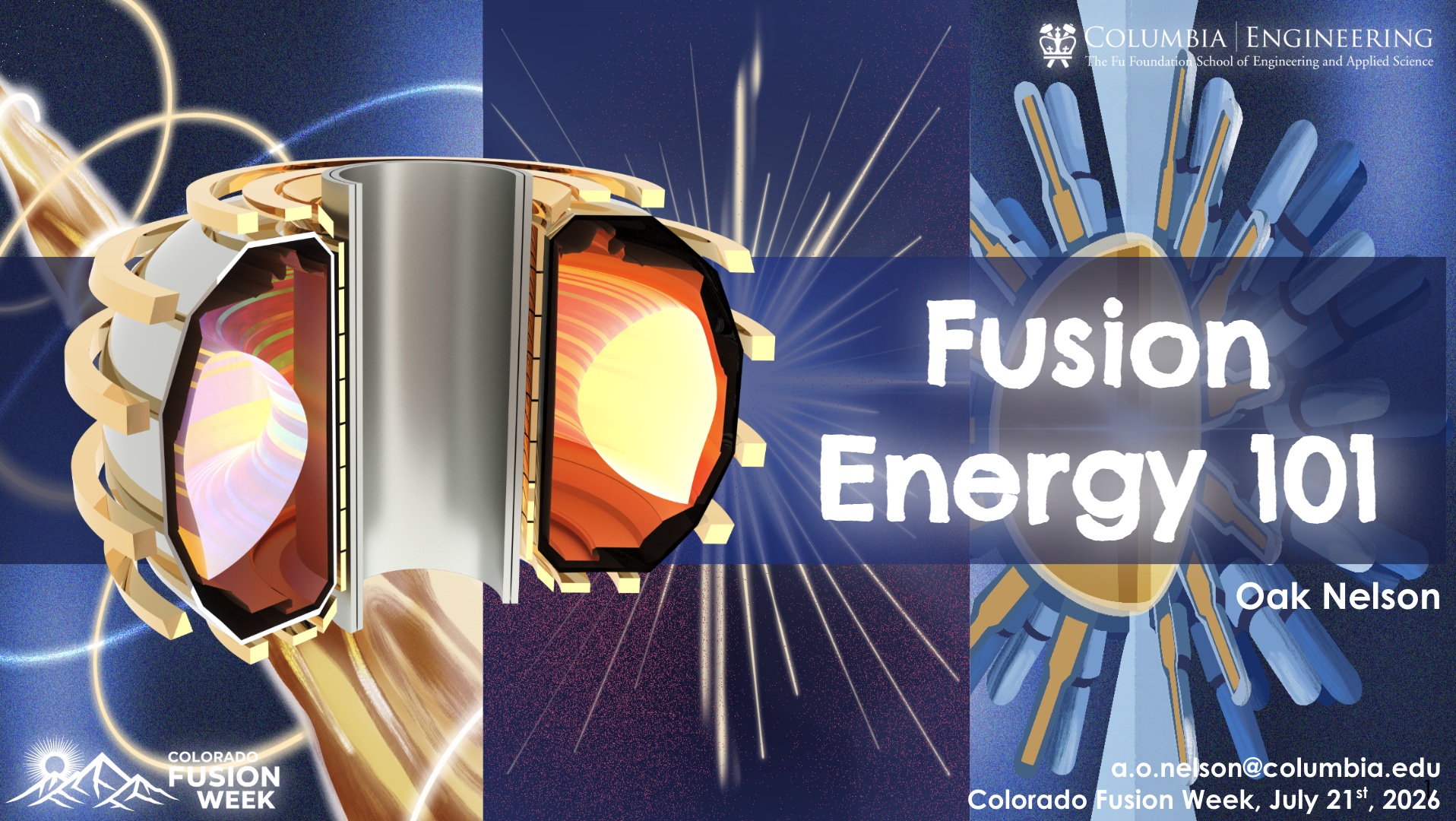 The title slide from my Fusion Energy 101 talk at Colorado Fusion Week.
I closed by emphasizing that the remaining challenges in fusion are highly interdisciplinary. Advances in lasers, magnets, materials, fuel cycles, and plant design and engineering will all be needed, which means there is room for people from nearly every technical background to contribute.
As someone who grew up in Colorado and studied engineering physics at CU Boulder, it was especially meaningful to return home for this event. Colorado already has a strong foundation in laser technology, optics and clean energy, and it was exciting to see so many companies, universities and state leaders in one room thinking about how the region can play a leading role in fusion. I am really looking forward to seeing the Colorado fusion community continue to grow, and hope to be back for Colorado Fusion Week 2027!